
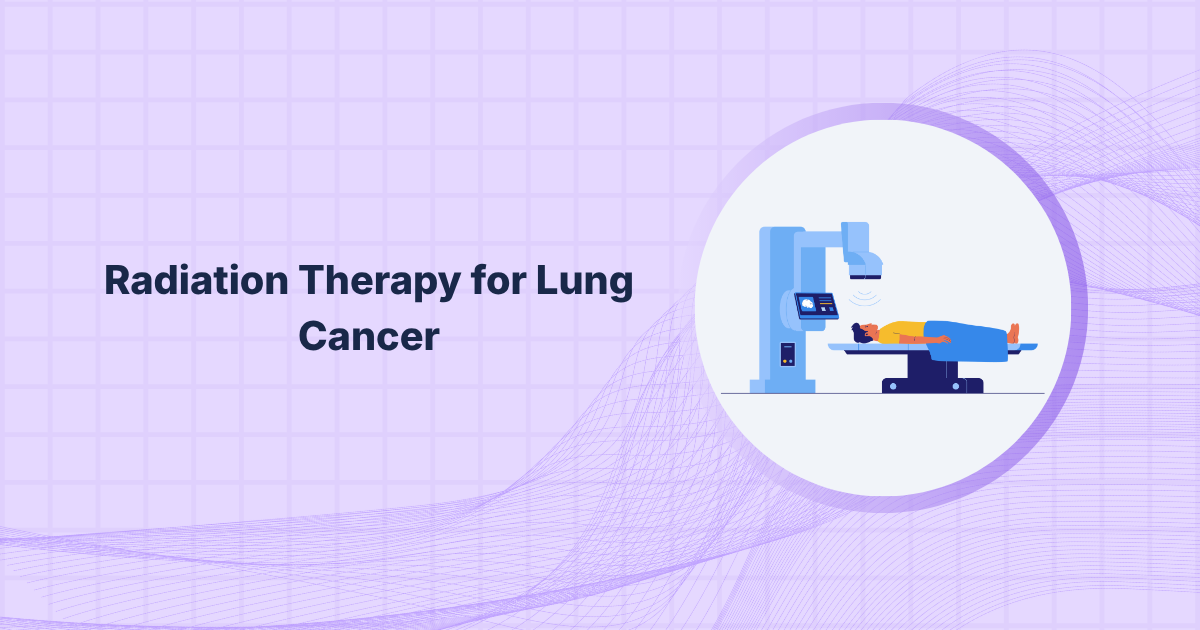
What Is Radiation Therapy for Lung Cancer?
Radiation therapy uses high-energy beams to damage cancer cell DNA, preventing tumour cells from dividing. Modern planning maximises dose to the tumour while protecting surrounding lung, heart, and oesophagus.
In lung cancer, radiation is used as a standalone curative treatment, combined with chemotherapy, before or after surgery, or to help relieve symptoms in advanced stages of the disease. The approach depends on cancer type, stage, tumour location, lung function, and overall health.
Types of Radiation Therapy for Lung Cancer
External Beam Radiation Therapy (EBRT)
EBRT directs focused beams from a linear accelerator at the tumour from outside the body. Conventional EBRT delivers small daily doses five days a week for 3-7 weeks - fractionation allows healthy tissue to recover between sessions. It is widely used for locally advanced NSCLC and SCLC, typically combined with chemotherapy.
Stereotactic Body Radiation Therapy (SBRT / SABR)
SBRT (stereotactic ablative radiotherapy / SABR) delivers very high radiation doses to small, well-defined tumours in just 1-5 sessions rather than several weeks of conventional EBRT. It is the standard non-surgical option for early-stage NSCLC in patients who cannot have surgery, achieving approximately 90% local control for peripheral tumours. Imaging is performed before each treatment session to confirm the tumour’s exact position and account for movement caused by breathing.
Intensity-Modulated Radiation Therapy (IMRT)
IMRT modulates the intensity and shape of radiation beams during treatment, allowing the dose to closely conform to the tumour while limiting exposure to nearby organs such as the lungs, heart, and oesophagus. It is especially useful for central tumours, associated with lower pneumonitis rates, and widely used for locally advanced NSCLC with concurrent chemoradiation.
3D Conformal Radiation Therapy (3D-CRT)
Proton Beam Therapy and Brachytherapy
Proton therapy uses charged protons that deposit energy at the tumour site and stop, reducing exposure to heart and surrounding lung. It is considered for re-irradiation or patients with anatomy that limits photon-based planning. Brachytherapy places a radioactive source in the airway via bronchoscope to relieve obstruction from central tumours - used primarily for palliation.
When Is Radiation Therapy Used in Lung Cancer?
Locally Advanced NSCLC (Stage III)
Concurrent chemoradiation - radiation given simultaneously with the standard platinum-based chemotherapy for unresectable Stage III NSCLC. Following chemoradiation, durvalumab immunotherapy is now standard consolidation therapy, based on the PACIFIC trial.
Small Cell Lung Cancer (SCLC)
In limited-stage SCLC, concurrent chemoradiation is standard - typically 45 Gy in 30 twice-daily fractions or a once-daily equivalent. For extensive-stage SCLC, radiation targets specific sites such as brain metastases or painful bone lesions. Prophylactic cranial irradiation (PCI) may be offered to chemo-responsive patients to reduce the risk of brain metastases.
Perioperative and Palliative Settings
Radiation therapy may be used before surgery (neoadjuvant therapy) to shrink the tumour and make it easier for surgeons to remove. After surgery (adjuvant therapy), it can help lower the chance of the cancer returning, especially if cancer cells remain at the surgical margins or if lymph nodes were affected. In more advanced cases, palliative radiation is used to ease symptoms such as bone pain, pressure on the spinal cord, or blockage in the airways, and it is often delivered over a short course of about one to five treatment sessions.
What to Expect During Radiation Treatment
Simulation and Planning
Before treatment starts, you attend a planning session (simulation) - a CT scan in your treatment position lasting 1-2 hours. Small tattoo dots are marked on your skin for precise repositioning. A customised immobilisation device holds you still at every session.
During Treatment Sessions
Sessions are painless. You lie still while the linear accelerator rotates around you. Conventional EBRT sessions take 15-30 minutes; SBRT sessions take up to an hour due to pre-treatment imaging. You remain awake throughout.
Treatment Scheduling
Conventional EBRT: five days a week for 3-7 weeks. SBRT: 1-5 sessions over 1-2 weeks. Palliative courses: 1-5 sessions.
Side Effects of Radiation Therapy for Lung Cancer
Side effects depend on the technique, dose, and whether chemotherapy is combined.
Common side effects include fatigue (which builds over weeks of daily treatment), oesophagitis (pain on swallowing - more common with concurrent chemoradiation), skin irritation, and cough.
Serious side effects to monitor:
- Radiation pneumonitis: It is an inflammation of lung tissue that can cause breathlessness, cough, and a mild fever, usually appearing 1-3 months after treatment. Techniques like IMRT lower this risk by targeting the tumour more precisely while protecting nearby healthy lung tissue.
- Radiation fibrosis: Scarring of the lung tissue that may cause long-term breathing difficulty. This typically develops months to years after radiation therapy.
- Cardiac toxicity: Higher radiation exposure to the heart has been linked to an increased risk of heart-related complications and mortality. Modern radiation planning techniques aim to limit the dose reaching the heart and reduce this risk.
Most acute effects resolve after treatment ends. Contact your cancer team promptly if you develop worsening breathlessness, fever, or difficulty swallowing.
Conclusion
Radiation therapy is an important part of lung cancer treatment and can be used in many different ways. Modern techniques allow doctors to target tumours more precisely while protecting nearby organs like the healthy lung tissue. Although side effects can occur, most are manageable and your care team will monitor you closely throughout treatment. Knowing what the process involves can help make radiation therapy feel less unfamiliar and easier to approach.