
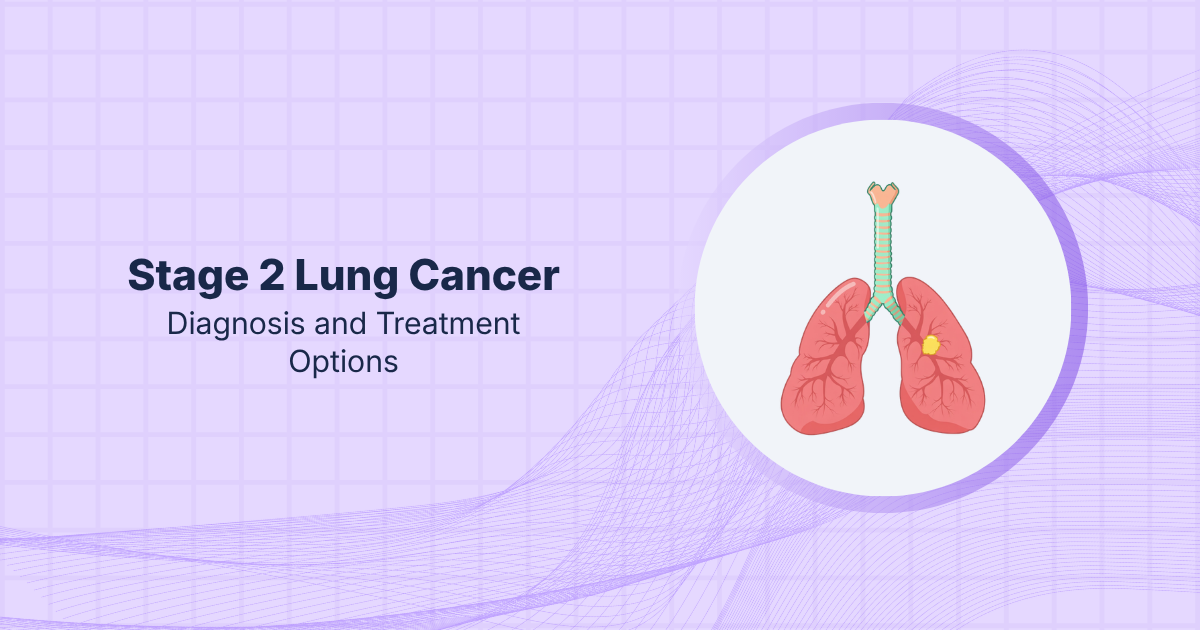
What Is Stage 2 Lung Cancer?
Stage 2 lung cancer is an early but locally progressed form of the disease. The tumour has grown larger than in Stage 1, or it has begun to spread to nearby lymph nodes within the chest but it has not reached distant organs such as the brain, liver, or bones. Treatment at this stage is usually aggressive and often aims for a cure.
Stage 2 is part of the non-small cell lung cancer (NSCLC) staging system. It sits between Stage 1, where the cancer is entirely confined to the lung and Stage 3, where the disease has spread to lymph nodes in the centre of the chest.
Stage 2A
The tumour measures between 4 cm and 5 cm with no lymph node spread. Some smaller tumours qualify as Stage 2A if they have begun to affect the main bronchus, grown into the visceral pleura (the membrane covering the lung), or caused partial airway obstruction.
Stage 2B
Stage 2B covers tumours between 5 cm and 7 cm without lymph node involvement, or smaller tumours that have spread to peribronchial or hilar lymph nodes on the same side as the tumour (N1 nodes). Tumours that have grown into the chest wall, pericardium, or diaphragm without distant spread also fall here.
In both sub-stages, the cancer remains within the chest. There is no distant metastasis, which is why surgical removal is still feasible for most patients.
Symptoms of Stage 2 Lung Cancer
Many patients with Stage 2 lung cancer have no symptoms. The cancer is often found incidentally when a chest CT is performed for an unrelated health problem. When symptoms do appear, they can include:
- Persistent cough that is new or worsens over weeks or months
- Coughing up blood or blood-streaked mucus (haemoptysis)
- Shortness of breath, even during light activity
- Chest pain when breathing deeply or coughing
- Unexplained fatigue that shows no improvement even on resting.
- Unintentional weight loss
- Wheezing or hoarseness if the tumour affects the airway or surrounding nerves
Many other respiratory disorders have similar characteristics. A doctor should be consulted for any symptoms that last longer than two to three weeks, particularly in individuals over 50 or those with a history of smoking.
How To Diagnose Stage 2 Lung Cancer?
Molecular tests to find targetable mutations, tissue sampling to confirm the type of cancer, and imaging to pinpoint the tumor are all necessary to confirm a Stage 2 diagnosis.
Diagnostic Steps
- X-ray of the Chest: Often the first test. It may reveal a suspicious mass, but it cannot confirm cancer or detect smaller tumours reliably.
- CT Scan of the Chest: This imaging test produces detailed cross-sectional pictures of the lungs. It helps doctors evaluate the size of the tumour, its location, and whether nearby lymph nodes appear involved.
- PET-CT Scan: In this test, a small amount of radioactive tracer is used to highlight areas with increased metabolic activity. It can help identify whether the cancer has spread to lymph nodes in the chest or to other organs that may not be clearly seen on a standard CT scan.
- Biopsy: A biopsy is performed to confirm the presence of cancer by examining a small tissue sample under a microscope. Tumours close to the airways are often sampled using bronchoscopy with endobronchial ultrasound (EBUS), while those located near the outer lung may be sampled using a needle guided by CT imaging.
- Mediastinoscopy or EBUS: If imaging suggests lymph node involvement, surgical or ultrasound-guided sampling of mediastinal nodes confirms the stage before treatment planning.
- Biomarker Testing: The tumour tissue is tested for EGFR, ALK, ROS1, KRAS G12C, MET, and BRAF V600E mutations, as well as PD-L1 expression. Results guide decisions on adjuvant therapy.
- Pulmonary Function Tests: These measure lung capacity to determine whether the patient can tolerate surgical removal of a lobe.
Treatment Options for Stage 2 Lung Cancer
Stage 2 NSCLC treatment is typically multimodal, combining more than one approach. The plan depends on the sub-stage, tumour location, cell type, biomarker results, and the patient's overall fitness.
Surgery
When the tumor can be completely removed, surgery is the mainstay of Stage 2 treatment. The most popular operation is a lobectomy, which involves removing the tumor-containing lobe. A pneumonectomy, or removal of the entire lung, can be required if the tumor is centrally placed.
Video-assisted thoracoscopic surgery (VATS) or robotic-assisted surgery is preferred where feasible, as these minimally invasive techniques cause less post-operative pain and allow faster recovery than open thoracotomy. Complete resection with no cancer cells at the cut margins gives patients the best long-term outcomes.
Adjuvant Chemotherapy
Adjuvant (post-operative) chemotherapy is recommended for most Stage 2 patients after surgery. It targets microscopic cancer cells that surgery may have missed and reduces the chance of recurrence. Platinum-based regimens, most commonly cisplatin combined with vinorelbine or pemetrexed, are given for three to four cycles over approximately three months.
Adjuvant Targeted Therapy and Immunotherapy
For patients whose tumours carry an EGFR mutation, the oral EGFR inhibitor osimertinib is recommended as adjuvant therapy for three years after surgery. The ADAURA trial showed that adjuvant osimertinib significantly reduced the risk of disease recurrence compared with placebo.
For patients with Stage 2B tumours and high PD-L1 expression but no EGFR or ALK mutations, adjuvant immunotherapy may be considered after chemotherapy. Treatment selection is guided by individual biomarker results.
Radiation Therapy
Post-operative radiation is not routinely used after a complete resection. It is recommended that when positive surgical margins are found, meaning cancer cells remain at the edge of the removed tissue. Stereotactic body radiation treatment (SBRT) is a proven curative option for patients who are not candidates for surgery due to poor lung function or other medical issues.
Survival Rate for Stage 2 Lung Cancer
The American Cancer Society reports a five-year relative survival rate of approximately 40% for regional-stage NSCLC, the SEER category that broadly corresponds to Stages 2 and early Stage 3, based on patients diagnosed between 2015 and 2021.
Individual outcomes depend on the specific sub-stage, whether the tumour was completely resected, the presence of targetable mutations, and response to adjuvant therapy. Patients with EGFR-mutant tumours treated with adjuvant osimertinib show disease-free survival rates significantly above historical averages. Survival statistics reflect patients treated in earlier years and are likely to improve for those diagnosed today.
Conclusion
Lung cancer in stage 2 is an intermediate stage where the tumor has enlarged or spread to neighboring lymph nodes without spreading to distant organs. In addition to additional therapies like chemotherapy or targeted therapy based on the features of the tumor, management typically entails surgery. Many patients are able to manage their illness and continue their care with a clear treatment plan when they receive the right care and routine follow-up. Don’t ignore persistent symptoms; speak to our lung cancer specialist for proper evaluation.