
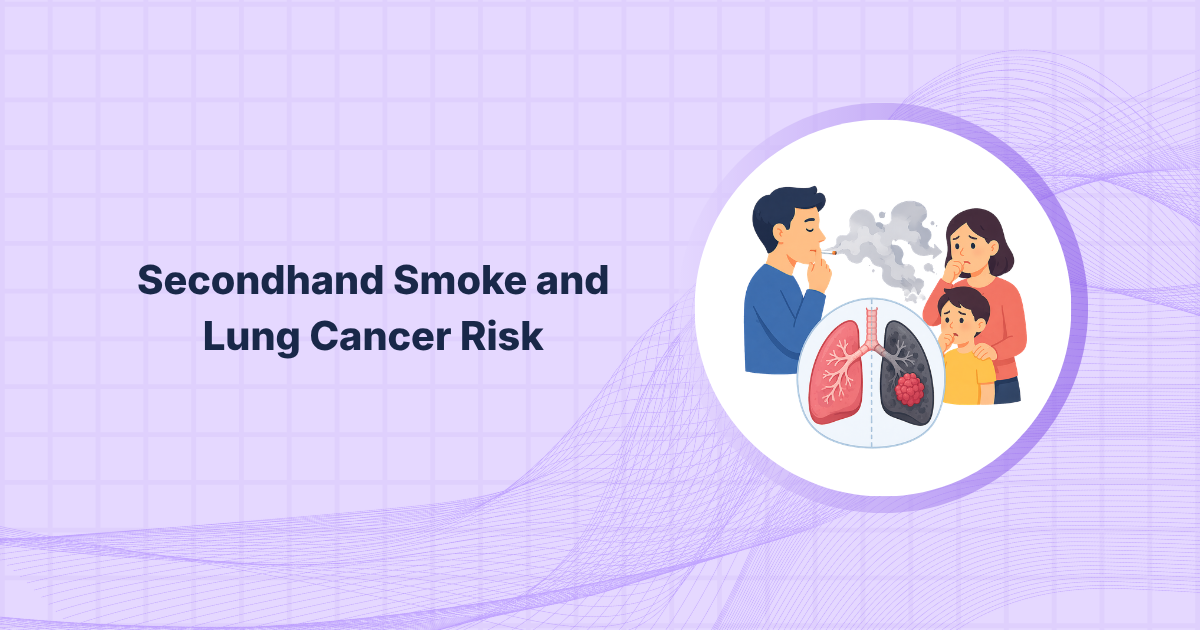
Secondhand Smoke and Lung Cancer Risk
Secondhand smoke is one of the major factors of lung cancer in people who have never smoked. The CDC confirms there is no safe level of exposure - even brief contact causes immediate harm. Non-smokers regularly exposed at home or work are at an increased risk of lung cancer.
What Is Secondhand Smoke and How Does It Cause Lung Cancer?
Secondhand smoke comes from two sources. The first is sidestream smoke, the smoke drifting from the burning end of a cigarette, cigar, or pipe. The second is mainstream smoke which a smoker exhales. Both types carry the same harmful chemicals.
When a non-smoker inhales secondhand smoke, they breathe in over 7,000 chemicals. At least 70 are known carcinogens substances that damage DNA in lung cells, including benzene, formaldehyde, arsenic, and polycyclic aromatic hydrocarbons. These are the same cancer-causing substances found in directly inhaled cigarette smoke.
The damage begins immediately. Harmful inflammatory and respiratory effects can appear within 60 minutes of exposure and persist for several hours. With repeated exposure over years, accumulated DNA damage in lung cells can trigger cancerous changes.
Since 1964, an estimated 2.5 million non-smokers have succumbed to health problems caused by secondhand smoke, according to the CDC.
How Much Does Secondhand Smoke Raise Lung Cancer Risk?
The link between lung cancer and secondhand smoke has been proven in studies.
Research published in the journal Lung Cancer found that the age of first exposure matters. Earlier and longer exposure is associated with a meaningfully higher lung cancer risk. Childhood exposure is especially concerning because developing lungs are more vulnerable to carcinogen damage.
The American Cancer Society confirms that non-smokers living with a smoker have a 20 to 30 percent higher risk of developing lung cancer compared to those not regularly exposed.
Workplace exposure also plays a significant role. People who spend long hours in smoking-permitted environments - such as hospitality settings - face elevated cumulative risk.
Where Does Secondhand Smoke Exposure Happen?
- Living with someone who smokes at home probably gives you the worst kind of exposure, like all the time and really strong. Those chemicals from the smoke just stick around on everything, surfaces and stuff, and they hang in the air even way after the cigarette is out. It seems hard to avoid that.
- In a car, its even worse in a way, because its so closed up. Even if you roll down the windows, the bad particles build up fast. I think thats why it feels so trapped.
- Workplaces where smoking is allowed, people there get hit with it every day. Just constant, you know. Not sure if thats changing much now, but it used to be common.
- Places around building entrances, outdoor seating near smokers, and enclosed transit spaces all present increased exposure risk.
Who Is at an Increased Risk?
Kids
When kids are around secondhand smoke, it really messes with them right away and even later on. Like, the short-term stuff hits hard with things like getting sick in the lungs, or those bad asthma episodes, and ear problems too. I think the immediate effects are the scariest because they show up so fast. Long-term ones are there but not as spelled out here. In infants, secondhand smoke is a confirmed risk factor for sudden infant death syndrome (SIDS).
While lung cancer in childhood is rare, the DNA damage from early exposure can increase adult lung cancer risk significantly. Children cannot remove themselves from these situations - protection depends entirely on the adults around them.
Pregnant Women
Pregnant women who are exposed to secondhand smoke face high risks including low birth weight and premature delivery.
How to Protect Yourself and Your Family?
The only reliable way to protect yourself from secondhand smoke is to eliminate exposure entirely. Ventilation systems and open windows reduce pollutant levels but do not remove the risk.
- Make your home smoke-free - Set a clear no-smoking rule indoors and ask visitors to smoke well away from windows and doors.
- Support smokers in quitting - Talk to those around you about quitting and point them toward stop-smoking programs, nicotine replacement therapy, and professional support.
- Choose smoke-free environments - Try to select restaurants, workplaces, and social venues that enforce smoke-free policies.
- Protect kids - Never allow smoking in vehicles or rooms where children spend time.
- Know your rights at work - In many regions, workplaces are legally required to be smoke-free. Raise concerns with your employer if indoor smoking is permitted.
Conclusion
Secondhand smoke is not only unpleasent but a serious health hazard for them. The smallest exposure can be extremely harmful and long term exporsure can increase the risk of developing the fatal lung cancer. The best way to protect yourself and your family is by avoiding smoke-filled environments and create smoke free spaces at home. Such small steps can help reduce exposure and make a big difference in long term health.