
Can Non-Smokers Get Lung Cancer?
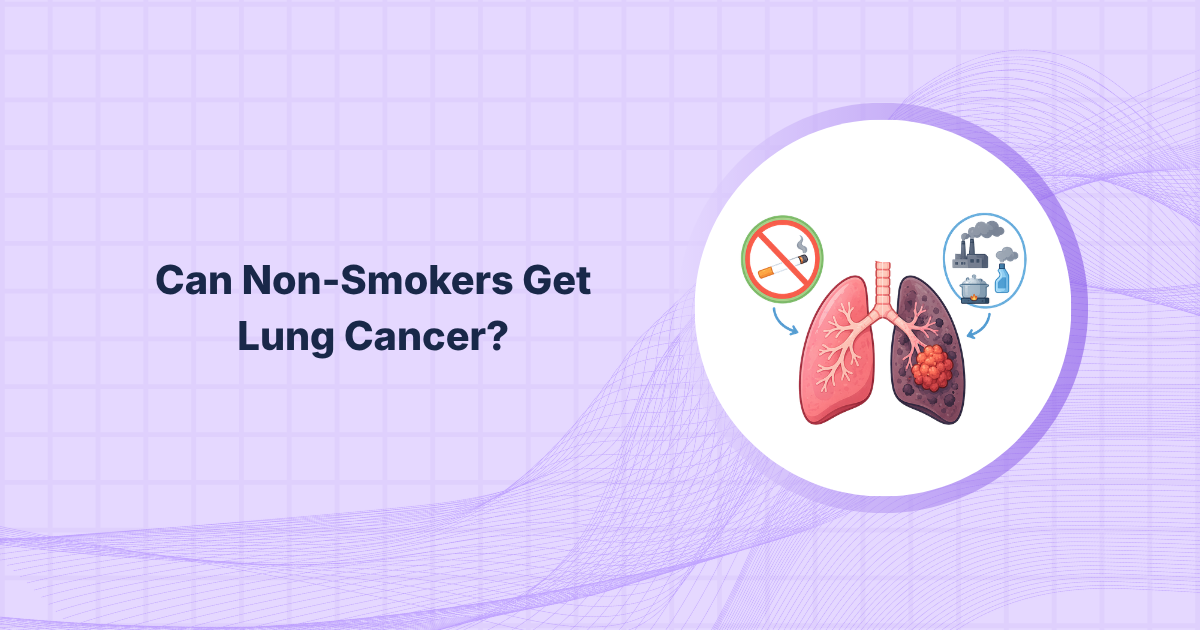
Yes, non-smokers can and do get lung cancer. According to the CDC, between 20,000 and 40,000 lung cancer cases are diagnosed each year in people in the United States who have never smoked. While smoking remains the leading cause, radon gas, secondhand smoke, air pollution, genetics, and other factors can all trigger lung cancer in people who have never touched a cigarette.
What Causes Lung Cancer in Non-Smokers?
Secondhand Smoke
Regularly breathing in other people's cigarette smoke is one of the most significant causes of lung cancer in non-smokers. The CDC estimates that secondhand smoke contributes to approximately 7,300 lung cancer deaths among non-smokers in the US each year.
The carcinogens in secondhand smoke are identical to those inhaled directly by smokers. Long-term exposure - at home, at work, or in enclosed public spaces - can cause the same DNA damage in lung cells over time.
Radon Gas
Radon is a radioactive gas that forms naturally from uranium in soil and rock. It seeps into buildings through cracks in the foundations and can build up to dangerous levels indoors without any visible signs or smell.
The CDC estimates radon causes around 2,900 lung cancer deaths in non-smokers annually in the US. It is one of the the leading environmental cause of lung cancer in non-smokers. Testing your home with an inexpensive radon kit is one of the most effective preventive steps a non-smoker can take.
Air Pollution
Long-term exposure to air pollution - particularly fine particle matter from vehicle exhaust, industrial emissions, and wildfire smoke - is a confirmed risk factor. Non-smokers who live near busy roads or industrial zones and breathe polluted air over many years face a higher cumulative risk.
Indoor air pollution, including cooking fumes from high-heat cooking without proper ventilation, has also been linked to lung cancer risk - particularly in studies of women in parts of Asia.
Genetic Mutations and Family History
Non-smokers who develop lung cancer are significantly more likely to have an underlying genetic mutation than smokers. These mutations in genes such as EGFR, ALK, and ROS1 cause lung cells to grow abnormally, independent of tobacco exposure.
According to Yale Medicine, the lung cancers that non-smokers develop are often driven by a specific molecular change that can be detected in the tumor. This is important because targeted therapies exist for many of these mutations, making treatment more precise and often more effective.
Occupational Exposure
Certain workplace substances are known lung carcinogens and can cause cancer in non-smokers exposed over long periods. These include:
- Asbestos -fibres that lodge in lung tissue and cause cellular damage over time.
- Arsenic, chromium, and nickel - heavy metals used in industrial processes.
- Diesel exhaust fumes - a risk for drivers, mechanics, and transport workers.
- Silica dust - common in construction, glass-making, and mining.
How Is Lung Cancer in Non-Smokers Different?
Lung cancer comes in different types, and both smokers and non-smokers can end up with them. I think the squamous cell kind shows up more in people who smoke, it forms this thick mass usually.
That seems pretty straightforward. Adenocarcinoma is the other one, it starts out in the outer parts of the lungs and spreads out more, kind of all over. Non-smokers get that more often, from what I recall.
It’s interesting how smoking links to one but not the other as much.
Yale Medicine describes this difference clearly: smoker's lung cancer tends to appear as a distinct mass, while the non-smoker's type is more spread out - less like a lump and more like a hazy area throughout the lung tissue.
Non-smoker lung cancers also tend to grow more slowly. However, because symptoms often go unnoticed until the disease is advanced, they are frequently diagnosed at a later stage.
What Are the Symptoms of Lung Cancer in Non-Smokers?
Common Symptoms
- Persistent cough that does not go away
- Shortness of breath or wheezing
- Chest pain that worsens with breathing or coughing
- Coughing up blood
- Unexplained weight loss or fatigue
Symptoms That May Appear Later
- Hoarseness or voice changes
- Swelling in the face or neck
- Difficulty swallowing
- Bone pain
Because non-smoker lung cancer often develops in the outer parts of the lungs, early symptoms can be subtle or entirely absent. This makes awareness of risk factors and proactive health checks - especially important.
How to Reduce Your Risk as a Non-Smoker
- Test your home for radon - Use an affordable test kit and take action if levels are elevated above safe limits.
- Avoid secondhand smoke - Steer clear of indoor smoking areas and encourage smokers around you to quit or smoke outdoors.
- Improve indoor ventilation - Ensure kitchens and living areas are well-ventilated, especially when cooking at high temperatures.
- Know your family history - If lung cancer runs in your family, speak to your doctor about genetic risk and screening options.
- Protect yourself at work - Follow all safety protocols and wear appropriate protective equipment when working around hazardous materials.
- Monitor air quality - On high-pollution days, limit time outdoors and use air purifiers indoors where possible.
Conclusion
Lung cancer is not only restricted to smokers. Factors like passive smoking, air pollution, genetics can increase the rish many folds. However, the good news is that many of these risks can be reduced by increasing awareness and payong attention to the symptoms. Taking small preventive steps and seeking medical care when something feels unusual can make a huge difference.