
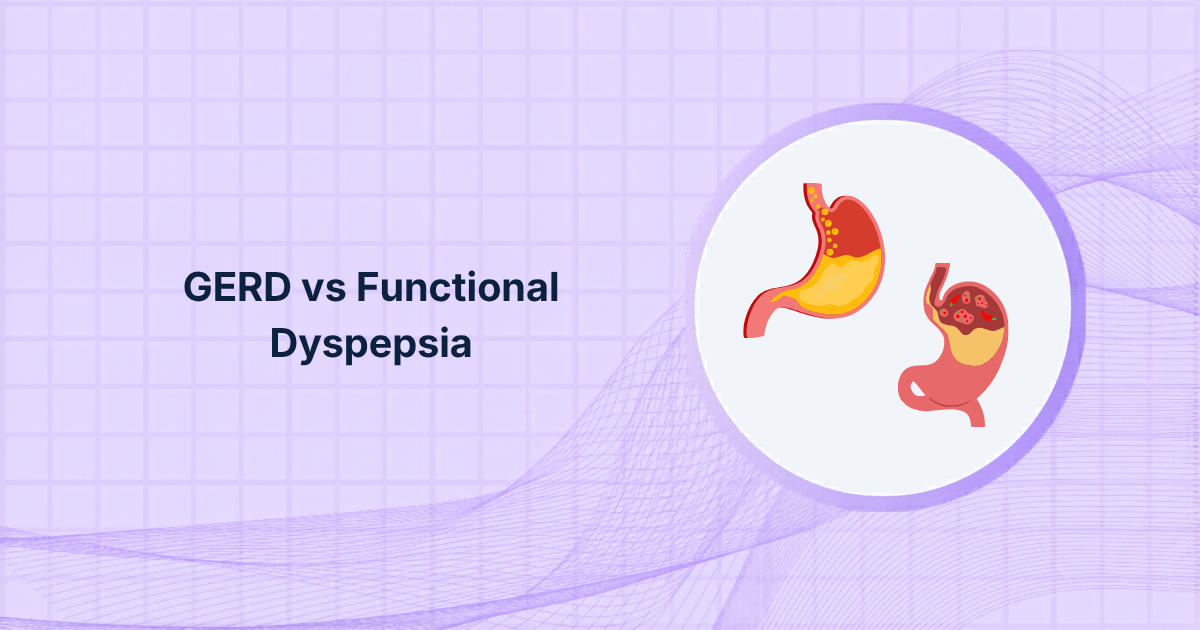
What Is the Difference Between GERD and Functional Dyspepsia?
Gastroesophageal reflux disease (GERD) and functional dyspepsia (FD) are the most frequently encountered upper gastrointestinal disorders in worldwide. These conditions often present as upper abdominal or thoracic pain especially around mealtimes. However, they differ in what causes them, which parts of the digestive system they affect, and how they are treated.
According to the Rome IV criteria (2016), functional dyspepsia affects approximately 10 to 20 percent of the global population, making accurate differentiation from GERD essential for effective treatment.
What Causes GERD and How Does It Affect the Esophagus?
When the LES isn't functioning properly and stays open too much, allowing stomach acid to enter the esophagus again and again, Gerd develops. Repeated acid exposure eventually causes the lining of the esophagus to become irritated and damages it producing symptoms of heartburn and regurgitation. With a longer and severe case, the chronic exposure can cause a condition called erosive esophagitis, Barrett's esophagus and esophageal adenocarcinoma.
Key risk factors for GERD include obesity, hiatus hernia, smoking, alcohol, and certain medications including calcium channel blockers and NSAIDs that relax the LES.
What Causes Functional Dyspepsia and How Is It Different From GERD?
Functional dyspepsia is a chronic disorder of gut-brain interaction characterized by persistent upper abdominal symptoms including early satiety, postprandial fullness, epigastric pain, and epigastric burning without any structural or biochemical abnormality to explain the symptoms.
Unlike GERD where measurable acid damage occurs in the esophagus, functional dyspepsia involves no identifiable tissue damage despite significant symptomatic distress.
Functional dyspepsia is caused by a combination of:
- Impaired gastric accommodation (the stomach failing to relax adequately to accommodate food after eating)
- Delayed gastric emptying causing food to remain in the stomach longer than normal
- Visceral hypersensitivity where the stomach is abnormally sensitive to normal levels of distension and acid
- Gut-brain axis dysregulation producing abnormal pain signaling between the stomach and brain
- Low-grade duodenal inflammation in some patients
According to the Rome IV criteria (2016), functional dyspepsia is divided into two subtypes:
- Postprandial distress syndrome (PDS): Predominantly meal-related symptoms including early satiety and postprandial fullness
- Epigastric pain syndrome (EPS): Predominantly epigastric pain or burning not exclusively triggered by meals
How Do the Symptoms of GERD and Functional Dyspepsia Differ?
Both GERD and functional dyspepsia can cause discomfort in the upper digestive area, but each tends to show its own pattern of symptoms that helps tell them apart.
GERD Symptoms
- Heartburn: A burning sensation rising from the stomach or lower chest toward the throat
- Regurgitation: A sour or bitter taste in the mouth from acid rising into the throat
- Symptoms triggered by lying down, bending over, and specific foods
- Symptoms typically improve with antacids and PPI therapy
- Dysphagia (swallowing difficulty) in severe or complicated GERD
- Chronic cough, hoarseness, and throat clearing in laryngopharyngeal reflux
Functional Dyspepsia Symptoms
- Postprandial fullness: An uncomfortable sensation of food remaining in the stomach long after eating
- Early satiety: Feeling full quickly after starting a meal, unable to finish normal-sized portions
- Epigastric pain: A pain or burning in the upper middle abdomen between the breastbone and navel
- Epigastric burning that is not heartburn and does not radiate toward the throat
- Nausea without vomiting in many patients
- Bloating and upper abdominal distension after meals
- Symptoms predominantly centered in the stomach area rather than the chest or throat
Key Symptom Differences
- GERD symptoms radiate upward toward the throat. Functional dyspepsia symptoms remain centered in the upper abdomen
- GERD is strongly triggered by lying down and posture changes. Functional dyspepsia is predominantly meal-triggered but is not typically worsened by lying flat
- GERD improves with antacids and acid suppression. Functional dyspepsia may partially improve with acid suppression but often requires additional treatments targeting gastric motility and gut-brain axis dysregulation
- Regurgitation is a hallmark of GERD. Regurgitation does not occur in functional dyspepsia
Can GERD and Functional Dyspepsia Occur Together?
Yes. GERD and functional dyspepsia co-exist in a significant proportion of patients.
A research carried out by the American Journal of Gastroenterology (2010) suggests that around 30-40% of people suffering from functional dyspepsia also fit the criteria for having GERD. The co-existence of the two disorders can make it difficult to diagnose and manage.
When both conditions co-exist, treating GERD with PPIs may partially improve symptoms but will not address the gastric motility and visceral hypersensitivity components driving functional dyspepsia. A combined treatment approach is required for patients with overlapping GERD and functional dyspepsia.
How Are GERD and Functional Dyspepsia Diagnosed?
Diagnosing GERD
- Clinical diagnosis usually relies on typical symptoms like heartburn and regurgitation that improve with PPI therapy.
- An upper endoscopy helps detect conditions such as erosive esophagitis or Barrett’s esophagus and rules out any structural issues.
- If the diagnosis is still unclear, esophageal pH monitoring is used to confirm abnormal acid exposure.
Diagnosing Functional Dyspepsia
Functional dyspepsia is a diagnosis of exclusion. Before functional dyspepsia is diagnosed, structural causes of upper abdominal symptoms must be excluded through:
- Upper endoscopy excluding peptic ulcer disease, gastric cancer, and esophagitis
- H. pylori testing as H. pylori infection causes similar symptoms and must be treated before functional dyspepsia is diagnosed
- Gastric emptying study to assess for gastroparesis (significantly delayed gastric emptying) which requires different management from functional dyspepsia
- Blood tests excluding thyroid disease, celiac disease, and other systemic causes
Functional dyspepsia is formally diagnosed using Rome IV criteria (2016) requiring at least one of the four cardinal symptoms (postprandial fullness, early satiety, epigastric pain, epigastric burning) present for at least 3 months with symptom onset at least 6 months before diagnosis.
How Are GERD and Functional Dyspepsia Treated Differently?
GERD Treatment
- PPI therapy is the most effective treatment, healing esophagitis in 78 to 95 percent of patients according to the AGA (2022)
- Lifestyle modifications including weight loss, dietary changes, and head of bed elevation
- Anti-reflux surgery for refractory GERD not controlled by PPI therapy and lifestyle changes
Functional Dyspepsia Treatment
Functional dyspepsia treatment is more complex than GERD and requires a multimodal approach:
- H. pylori eradication: If H. pylori is present, eradication therapy is the first treatment step and produces symptom improvement in approximately 10 percent of patients
- PPI therapy: Effective for the epigastric pain syndrome (EPS) subtype of functional dyspepsia with significant epigastric burning. Less effective for postprandial distress syndrome (PDS)
- Prokinetic agents: Medications including itopride and domperidone improve gastric motility and accommodation. They benefit the PDS subtype with early satiety and postprandial fullness
- Low-dose tricyclic antidepressants (TCAs): Amitriptyline and nortriptyline reduce visceral hypersensitivity and gut-brain axis dysregulation. This improves overall functional dyspepsia symptoms
- Psychological treatments: Cognitive behavioral therapy (CBT) and gut directed hypnotherapy target the gut-brain dysregulation causing functional dyspepsia.
- Dietary changes: Small and frequent meals, low fat diet and avoidance of carbonated drinks decrease triggers for functional dyspepsia.
Conclusion
GERD and functional dyspepsia are different conditions but co-exist together. By knowing the differences in the characteristic pattern of symptoms, pathophysiology, and the treatment used the management of each condition is tailored accordingly.
If you have persistent upper abdominal or chest symptoms that have not been properly evaluated, seek medical assessment with upper endoscopy and appropriate testing to confirm the diagnosis and guide the right treatment plan.